
Knowledge Base

Air Suspension, Explained

Everything a South African owner should know before bagging a car — how the system works, what a complete airride kit actually contains, how AIRBFT kit codes are read, and what living with air suspension is like on local roads.

How air suspension works

An airride system swaps the coil spring for an air spring and adds a small compressed air plant to the car. Four stages do the work:

01

Compressors build pressure

Twin silent compressors draw air through a filter and feed a seamless steel tank. Most street systems run a working range of roughly 120–150 PSI, with auto-drain water traps pulling moisture out before it reaches the valves.
02

The valve block meters air

A four-corner (V4) solenoid block opens and closes to fill or exhaust each air spring. Independent corners let you level the car on a camber, kneel one side, or lay it out evenly.

03

Management reads and holds height

The AIRBFT P3 controller stores presets and monitors tank pressure. Pressure-based management holds a set PSI per corner; height-sensor management holds a measured ride height regardless of load.

04

Air springs carry the car

Bellows or an integrated strut airbag replaces the coil spring. Air is progressive by nature, so the spring rate rises as it compresses — that is why a bagged car can ride softly on the highway and still resist bottoming out.

Anatomy

Every part, and what it does

Air struts / air shock absorbers

A damper and high-pressure airbag in one housing. AIRBFT units offer 32-segment damping adjustment so rebound can be firmed up separately from ride height.

Bellows (double convoluted)

Used where the spring and damper are separate — most rear axles, bakkies and vans. Double bellows give travel and load capacity; a softer rubber compound helps the car sit lower on the bump stop.

Valve block / manifold

V4 means four inlet and four exhaust solenoids — one pair per corner. Integrated blocks shorten air lines, which speeds up response and reduces leak points.

Management (P3)

The brain: tank pressure display, per-corner control, three presets, wired LCD remote and Bluetooth app. Can raise on start-up and lower on shut-down automatically.

Compressors

Duty cycle matters more than headline PSI. Dual silent compressors fill a 3–5 gallon tank quickly and stay quiet enough for a daily driver.

Seamless air tank

Seamless (not welded-seam) steel tanks handle pressure cycling better. Ports are used for the compressors, feed line, pressure sensor, drain and a safety valve.

Air line and fittings

Usually 1/4" DOT line for feed and 1/8" or 1/4" at the bags. Push-to-connect fittings with a rubber ring seal, non-return valves rated 0–150 PSI, and clean routing away from heat and moving suspension.

Electrical protection

A 200 amp relay for the compressors plus ANL fuse holders (80 A / 100 A, 1–4 way) fused at the battery. Correct fusing is the difference between a fault and a fire.

Reading a kit code: V4-P3-C2-T3

AIRBFT part numbers describe the configuration, not a model name. Each block tells you one thing about the system:

V4

Four-corner valve block — independent control of each wheel.

P3

P3 management generation: LCD remote, Bluetooth app, three presets.

C2

Two compressors (dual silent) for faster fill and shorter duty cycles.

T3

Tank specification — capacity and port configuration of the seamless tank.

Checklist

What a complete install needs

  • Front air struts or bellows matched to your exact chassis code
  • Rear air struts, or bellows plus a shock for separated setups
  • V4 valve block (integrated with the management on P3 kits)
  • Management head unit, wired LCD remote and Bluetooth module
  • Dual silent compressors with mounting feet and intake filters
  • Seamless air tank with drain and safety valve
  • Auto-drain water traps to keep moisture out of the valves
  • 200 amp relay, ANL fuse holders and a full wiring loom
  • DOT air line, push-to-connect fittings and non-return valves
  • Professional fitment, four-wheel alignment and a leak-down test
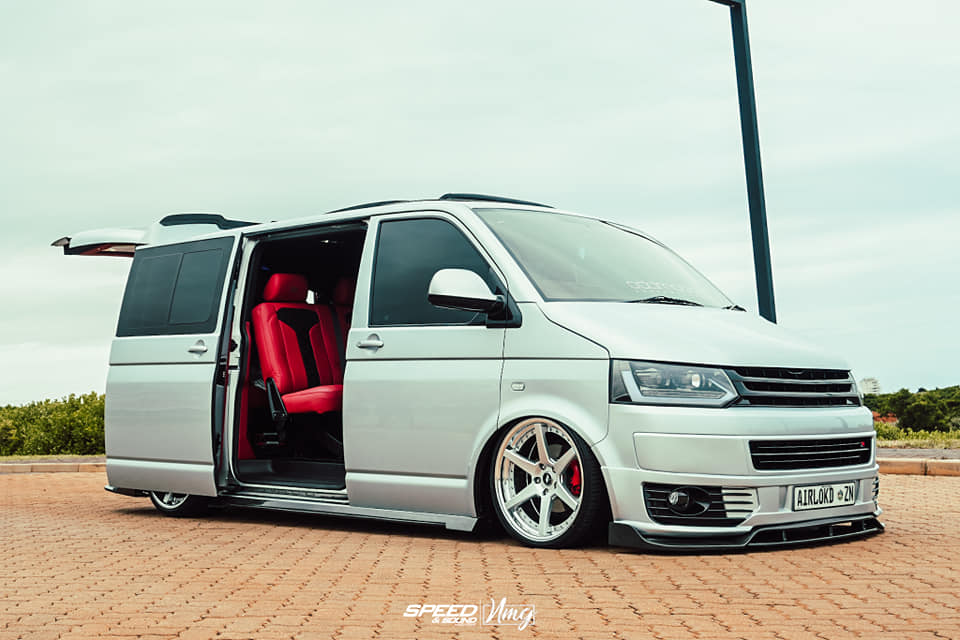
Volkswagen Transporter laid out on AIRBFT air suspension in South Africa

Air suspension vs coilovers

Comparison of air suspension and coilovers for South African road use
FactorAir suspensionCoilovers
Ride heightAdjustable on demand, from laid out to factory heightFixed once set
Ride qualityProgressive spring rate — comfortable at speedFixed rate, firmer over broken tar
Speed bumps & drivewaysRaise on approach, lower again afterLive with the clearance you chose
Load carryingAdd pressure to level under loadSags with load
ComplexityCompressors, tank, valves and wiring to maintainPurely mechanical
Best forDaily-driven show and street cars, bakkies, vansTrack and time-attack builds

Living with it: maintenance

Drain the tank monthly — South African summer humidity puts water into the system.

Check the auto-drain traps and compressor filters every service interval.

Soapy-water test fittings after the first 200 km, then annually.

Re-torque strut hardware and re-align after the first week of settling.

Listen for a compressor cycling at rest — that is a leak, not a quirk.

Glossary

Airride
Common name for a full air suspension system with on-demand height adjustment.
Bellows
A rubber air spring, usually double convoluted, used where spring and damper are separate.
Duty cycle
How long a compressor can run before it needs to cool — lower cycles mean longer life.
Laid out
The car resting at its lowest possible height with the bags fully exhausted.
Notching
Modifying a chassis rail or boot floor to clear the axle or bag at full drop.
PSI
Pounds per square inch — the pressure unit used for tank and corner readings.

Answers

Air suspension FAQs

What is air suspension and how does it work?

Air suspension replaces the coil springs with air springs (bellows or integrated air struts). Compressors fill a pressurised tank, a valve block feeds or exhausts each corner, and a management controller holds the height or pressure you choose. Because air is progressive, the spring rate rises as the bag compresses, which is why a bagged car can be soft at cruising speed yet still control body roll.

Is air suspension legal in South Africa?

Air suspension is legal on South African roads provided the vehicle is roadworthy at the height it is driven: headlights aimed correctly, no tyre or bodywork fouling, and no compromised braking or steering geometry. Drive at a sensible ride height, keep the system leak-free, and have the car aligned after fitment.

Does air suspension ride better than lowering springs or coilovers?

For daily driving, usually yes. Air springs are progressive and the AIRBFT struts add 32-segment damping adjustment, so you can run a soft highway setting and still firm up for spirited driving. Coilovers remain the choice for fixed-height track work.

How low can my car go on AIRBFT air suspension?

That depends on chassis, wheel and tyre fitment and whether the boot floor or chassis rails have been notched. Most cars on a correctly specified AIRBFT kit will lay the sills within a few centimetres of the ground, and rise to well above factory height for driveways and speed bumps.

What does a kit code like V4-P3-C2-T3 mean?

V4 is a four-corner valve block, P3 is the management generation with LCD remote and Bluetooth app control, C2 means two compressors and T3 describes the tank specification. Message AIRBFT South Africa with your vehicle and we will spec the correct combination.

What is included in a complete AIRBFT airride kit?

Front and rear air shock absorbers, double bellows sets, P3 management with an integrated solenoid block, a 200 amp relay, a seamless air tank, dual silent compressors, dual auto-drain water traps, the full wiring loom and air piping, a fuse holder and fittings — everything AIRBFT, nothing mixed and matched.

How long does fitment take?

A typical passenger car takes one to two working days: strut and bellows installation, boot or under-body mounting of the tank and compressors, air-line routing, wiring and fusing, then calibration, a leak-down test and a four-wheel alignment.

Can I still carry loads or tow?

Yes — that is a strength of air. Add pressure to level the rear under load, which keeps headlights aimed correctly and the ride height stable. This is why bakkies, vans and Alphards are popular air suspension conversions.

How much maintenance does air suspension need?

Very little. Drain moisture from the tank monthly, keep the compressor filters clean, and check fittings with soapy water once a year. A compressor that cycles while the car is parked is signalling a leak.

Which cars does AIRBFT South Africa support?

Applications cover Audi, BMW, Mercedes-Benz, Porsche, Volkswagen, Toyota, Honda, Nissan, Lexus, Tesla, Ford, Dodge RAM, Land Rover, Tank 300, Bentley, Aston Martin and Acura, including bakkies and vans such as the Ranger, Raptor, RAM TRX, T6 and Alphard. Custom applications are available on request.

Where can I buy AIRBFT air suspension in South Africa?

AIRBFT is distributed in South Africa by Grounded Art Importers in Bryanston, Johannesburg, with nationwide supply. Browse the range on this site and order through groundedart.co.za, or message us on WhatsApp on 082 468 1532 for a kit recommendation.

Do AIRBFT kits come with a warranty?

Yes — AIRBFT products carry a one-year warranty, supported locally by Grounded Art Importers.

Kit codes like V4-P3-C2-T3 describe the valve block, management, compressor and tank configuration — message us and we'll spec the right kit for your car.

Spec my kit
Chat to AirbftSA